

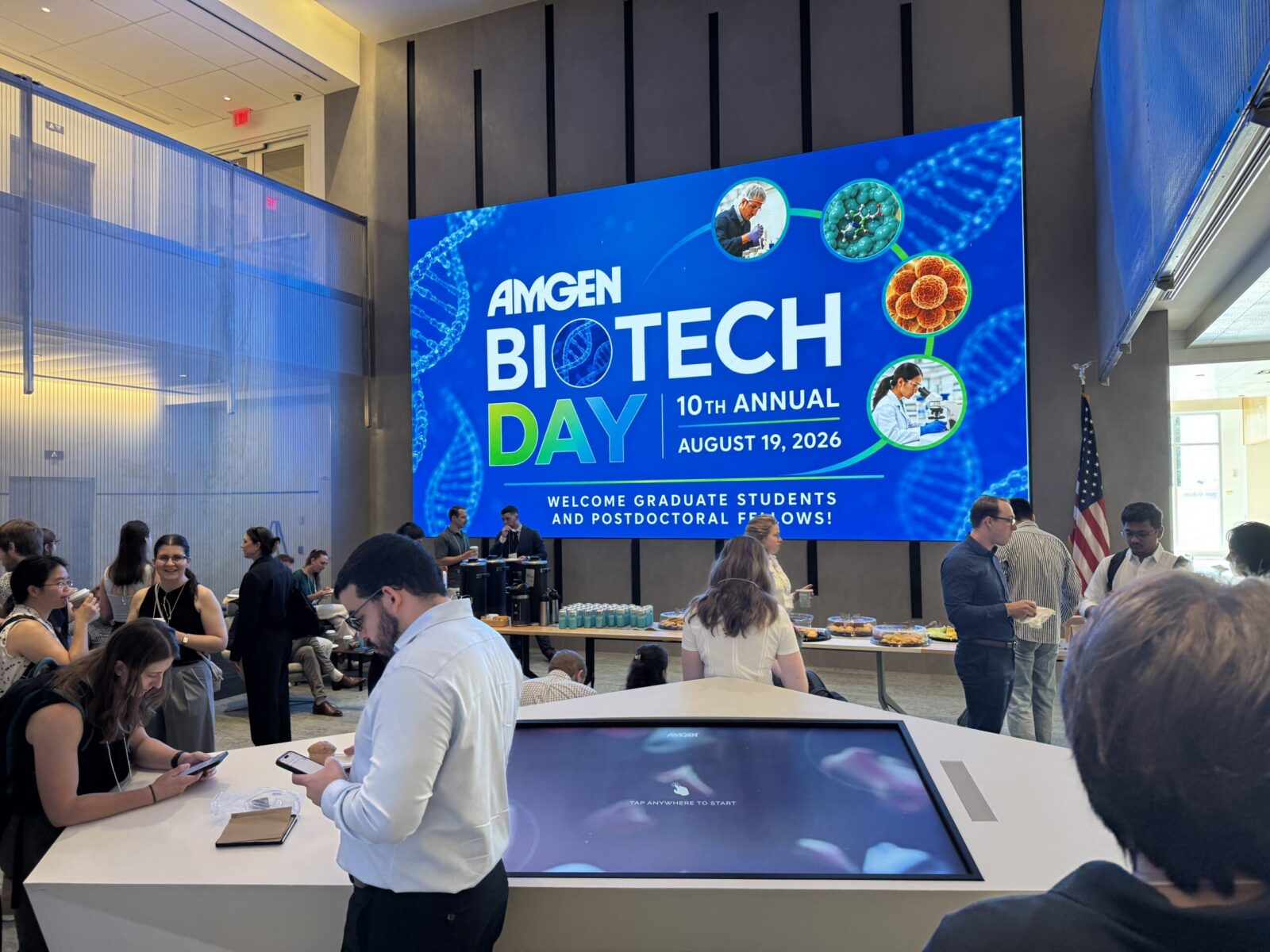
CAMBRIDGE, Mass. — Amgen Massachusetts hosted its 10th Annual Amgen Biotech Day on August 19, bringing together more than 100 graduate students and postdoctoral scholars from more than 20 institutions across New England for a day of scientific learning, career exploration and networking.
The event is designed to help bridge the gap between academia and industry by giving early-career scientists a closer look at how biotechnology research is translated into medicines.
Programming included presentations from Amgen scientists and leaders on data science, machine learning, process chemistry, biologics development and multi-omics research. Attendees also participated in career discussions, laboratory tours and a networking reception.
“For ten years, Amgen Biotech Day has given students and early-career scientists the opportunity to see what biotechnology looks like from the inside while connecting directly with the people behind the science,” said Margaret Faul, Vice President of Drug Substance Technologies and Site Head of Amgen Massachusetts. “We hope the experience broadens perspectives on the many ways scientists can improve patients’ lives and helps inspire the next generation of leaders in our industry.”
Amgen Massachusetts is home to the company’s Operations East Coast Innovation Center in Kendall Square. The Cambridge-based team focuses on turning scientific discoveries into scalable and manufacturable medicines by developing processes, technologies and product innovations needed to bring new therapies to patients.
The site plays a particular role in process development and manufacturing innovation, complementing the early-stage discovery work conducted by many other biotechnology organizations in Kendall Square.
This year’s event also comes as Amgen Massachusetts marks its 25th anniversary in Cambridge. Since establishing its local presence, the company has been part of Kendall Square’s growth into one of the world’s leading biotechnology hubs.
Amgen said the Massachusetts site continues to serve as a center for scientific innovation, workforce development and collaboration within the state’s life sciences ecosystem.