

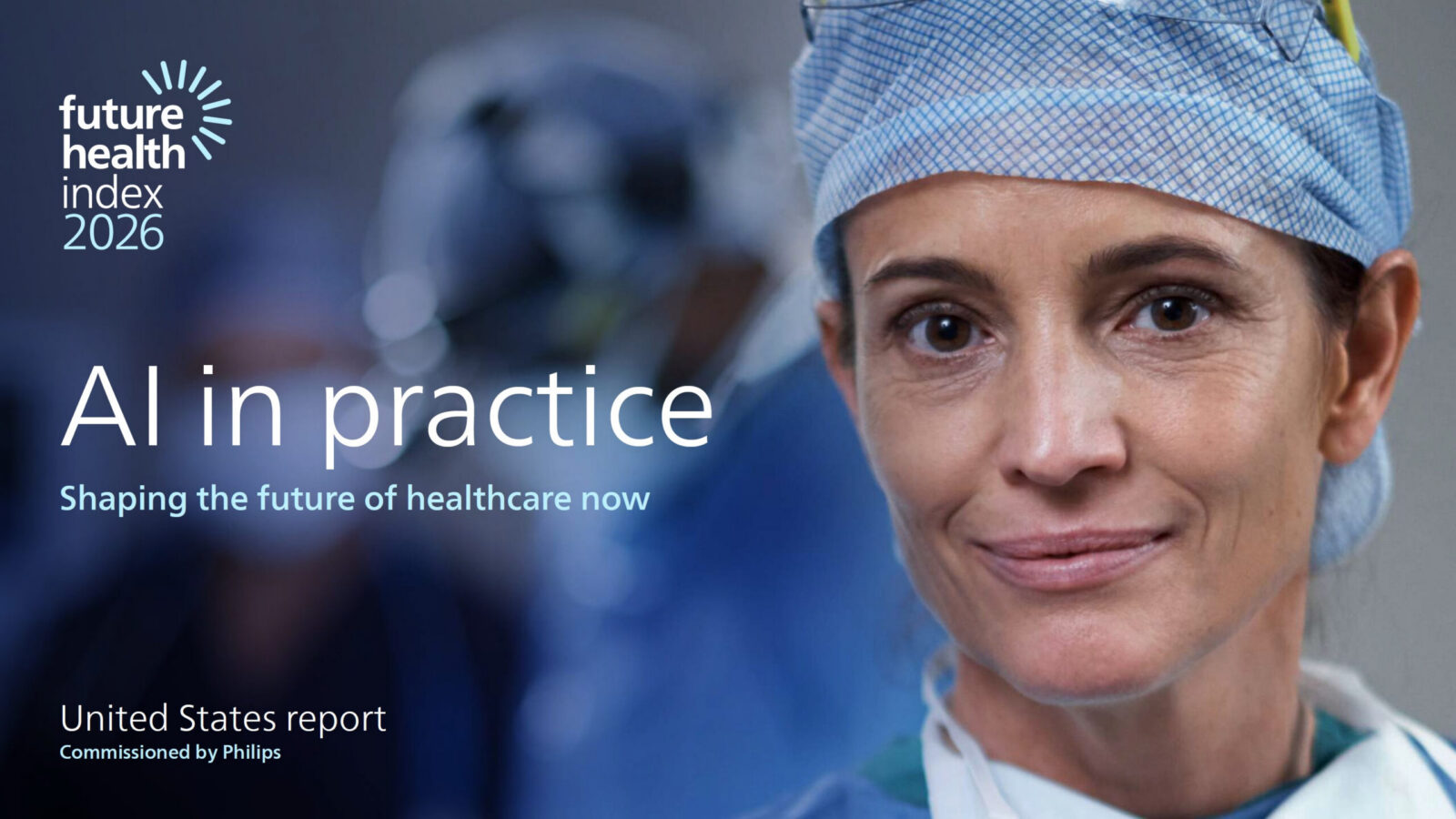
Cambridge, Mass. — Royal Philips has released its 2026 Future Health Index U.S. report, finding that artificial intelligence is increasingly being used in clinical workflows to help healthcare professionals expand capacity, save time, reduce burnout and improve care delivery.
The report, titled “AI in practice: Shaping the future of healthcare now,” found that AI is delivering measurable benefits across healthcare systems facing rising demand, workforce shortages and higher costs.
According to the report, 36% of healthcare professionals said AI has increased their capacity to see more patients, with clinicians reporting a median increase of five additional patients per week.
Nearly half of clinicians, or 49%, said AI saves them at least 132 hours per year on average, equivalent to more than three full working weeks. Philips said that time is being redirected toward higher-value clinical work, including reviewing cases in greater detail.
The report also found that 27% of healthcare professionals said AI helped them identify or prevent a potential medical error at least three times in the past three months. Clinicians also reported improvements in well-being, including better work-life balance, reduced work-related stress and less overtime or work taken home.
Philips said AI adoption is becoming nearly universal among healthcare providers. The report found that 74% of clinicians said their use of AI-enabled tools provided by their organization increased over the past year, while 73% said AI-enabled tools are saving time.
Clinicians said they are using the regained time to focus more on patient care, clinical decision-making and higher-value work, as well as staying current with research and clinical developments.
The report also points to the emergence of a “hybrid care team,” in which AI supports clinicians and patients while human judgment remains central. A majority of clinicians said they are comfortable with AI supporting decisions as a partner in areas such as diagnostic decision support, medical image analysis, medical imaging processing and surgical guidance. More than 90% said it is essential to keep a human in the loop as AI advances.
However, Philips said readiness challenges remain. Nearly eight in 10 healthcare professionals said training for AI-enabled tools is limited or inconsistent at their organization, highlighting the need for stronger infrastructure, workforce readiness and governance.
“The growth in adoption of AI over the last year has been nothing short of remarkable – and healthcare leaders are increasingly seeing an AI dividend. Their investments are giving time back to clinicians and improving the patient experience,” said Jeff DiLullo, Chief Region Leader, Philips North America. “We’re still in the early days of this transformation. To realize these benefits across the broader healthcare ecosystem and have impact at scale, AI must be embedded seamlessly into clinical workflows and supported by consistent education and training.”
The Future Health Index is a global survey examining the views of healthcare professionals and patients across multiple countries. The 2026 edition is based on proprietary quantitative research involving more than 2,000 healthcare professionals and more than 20,000 patients across 10 countries.