

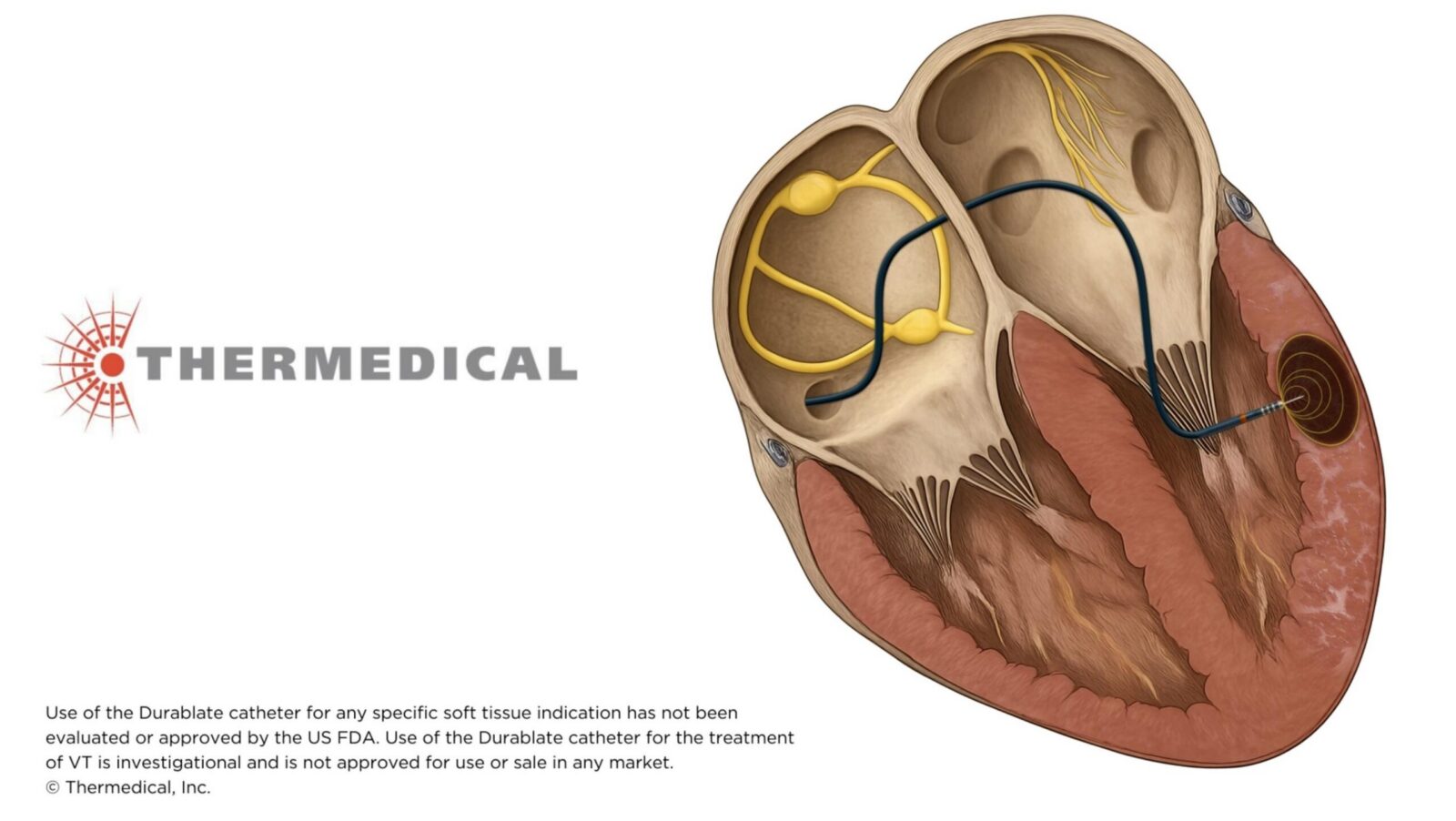
WESTON, Mass. — Thermedical, a developer of advanced thermal-ablation technologies, has named nine medical and research experts to oversee its pivotal clinical study of the Saline Enhanced Radiofrequency (SERF) Ablation System with the Durablate Catheter for patients with recurrent ventricular tachycardia (VT).
The study is evaluating SERF ablation in patients whose condition persists despite antiarrhythmic medications and previous catheter ablation procedures.
The independent oversight team includes eight electrophysiologists and a biostatistician from leading academic medical institutions in the United States and Canada. The experts will serve on the study’s data safety monitoring board (DSMB), clinical events committee (CEC) and arrhythmia core laboratory.
Wendy S. Tzou, MD, Director of Cardiac Electrophysiology at the University of Colorado School of Medicine, will chair the DSMB. John Sapp Jr., MD, Professor in the Division of Cardiology at Dalhousie University, will chair both the CEC and the arrhythmia core lab.
“The patients in this study have VT that keeps coming back after medications and multiple ablations, and they deserve a study run with uncompromising rigor,” said Dr. Michael Curley, Inventor of SERF Ablation and Co-Founder and CEO of Thermedical. “These are among the most respected names in electrophysiology and clinical research. Their independent review of every safety event and arrhythmia outcome means the results of this study will stand on their own.”
The data safety monitoring board will periodically review safety and effectiveness data, monitor adverse events and recommend modifications or termination of the study if necessary to protect participants.
In addition to Tzou, the board includes John M. Miller, MD, Professor of Medicine at IU Health’s Krannert Cardiovascular Research Center; Henry Huang, MD, Director of Cardiac Electrophysiology at the University of Chicago; and George Wells, PhD, a biostatistician at the University of Ottawa Heart Institute.
The clinical events committee, responsible for reviewing adverse events and evaluating critical safety endpoints, includes Sapp, Jaimie Manlucu, MD, Associate Professor of Medicine at Western University, and Jeanne Poole, MD, Professor of Medicine at UW Medicine.
The arrhythmia core laboratory will assess tachyarrhythmia events throughout the trial. Alongside Sapp, its members include Alfred E. Buxton, MD, Ben-Haim Josephson Professor of Medicine at Harvard Medical School and a physician at Beth Israel Deaconess Medical Center, and Andre d’Avila, MD, PhD, Director of the Cardiac Arrhythmia Service at the Harvard Thorndike Electrophysiology Institute.
Thermedical also announced that David J. Callans, MD, Associate Director of Electrophysiology at the University of Pennsylvania Health System, will present early results from the study at VT Symposium 2026 in Brooklyn on Oct. 9.
His presentation, titled “Saline-Enhanced Radiofrequency (SERF) Ablation for VT,” is scheduled for 5:30 p.m. EDT during the symposium’s session on treating difficult-to-reach arrhythmias.
The SERF-VT Ablation Study (NCT05337241) enrolled its first patient in December 2025 at the Montreal Heart Institute, and enrollment remains ongoing.
The study builds on earlier feasibility research and is supported by a $3 million grant from the National Heart, Lung, and Blood Institute.