


Cambridge, Mass.– Zifo said biopharma companies should move away from linear Design-Make-Test-Analyse workflows and toward connected scientific networks that preserve data, context and decision-making throughout drug development.
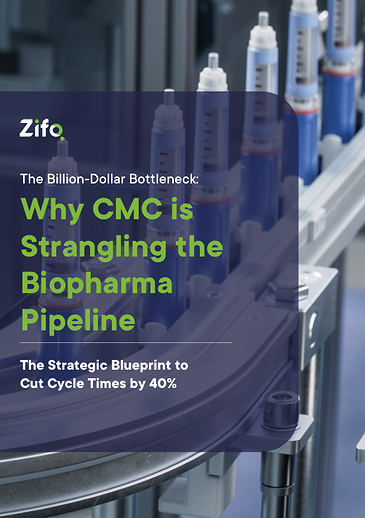
In a new position paper, “The Billion-Dollar Bottleneck: Why CMC Is Strangling the Biopharma Pipeline,” the company argues that disconnected experiments, fragmented evidence and repeated manual reconstruction of scientific context are slowing learning across the biopharma development process.
Zifo describes the problem as the “DMTA doom loop,” in which Design-Make-Test-Analyse processes are forced into a sequential model rather than adapting to the needs of scientists and individual experiments.
The company said the traditional model can result in scientific information being spread across laboratory applications, instruments, spreadsheets, reports, PDFs, batch records and presentations. Researchers may then need to locate data, reconcile sample identifiers and reconstruct experimental histories before interpreting results or planning subsequent work.
According to the paper, the larger problem is not simply fragmented data, but the loss of scientific context and decision-making knowledge as information moves between systems, teams and stages of development.
Zifo said scientific results should remain connected with the samples, methods, process conditions and reasoning that produced them.
The paper also argues that simply digitizing existing workflows or adding additional standalone applications will not necessarily solve the problem. Moving inefficient processes into rigid digital systems, Zifo said, can create faster versions of the same fragmented workflows.
Instead, the company recommends a connected scientific network that allows scientists and engineers to move between Design, Make, Test and Analyse activities as needed while retaining access to historical information, experimental intent, test results and previous decisions.
Under the proposed model, experimental data and context would remain connected across the development lifecycle, allowing new knowledge to be reused in subsequent experiments and by downstream teams.
Zifo also called for an orchestration layer capable of connecting scientific activity across existing systems of record without replacing validated core systems.
The company said such an environment should bring together the information and context needed for specific scientific tasks while reducing the need for researchers to manually navigate multiple applications and reconstruct relationships between data.
The paper also proposes the use of governed Scientific Language Models grounded in proprietary scientific evidence. Zifo said these models could help organizations capture and interact with scientific knowledge while maintaining traceability to the underlying data.
Rather than replacing existing technology infrastructure, Zifo recommends targeted integrations and smaller “lighthouse” implementations focused initially on high-value scientific workflows.
The company said the goal should be to shift drug development from completing isolated experiments toward building and compounding organizational knowledge with each experiment or test.
Zifo said achieving that model would require collaboration across chemistry, manufacturing and controls, process development, analytical development, quality, manufacturing, IT, data and scientific informatics.