
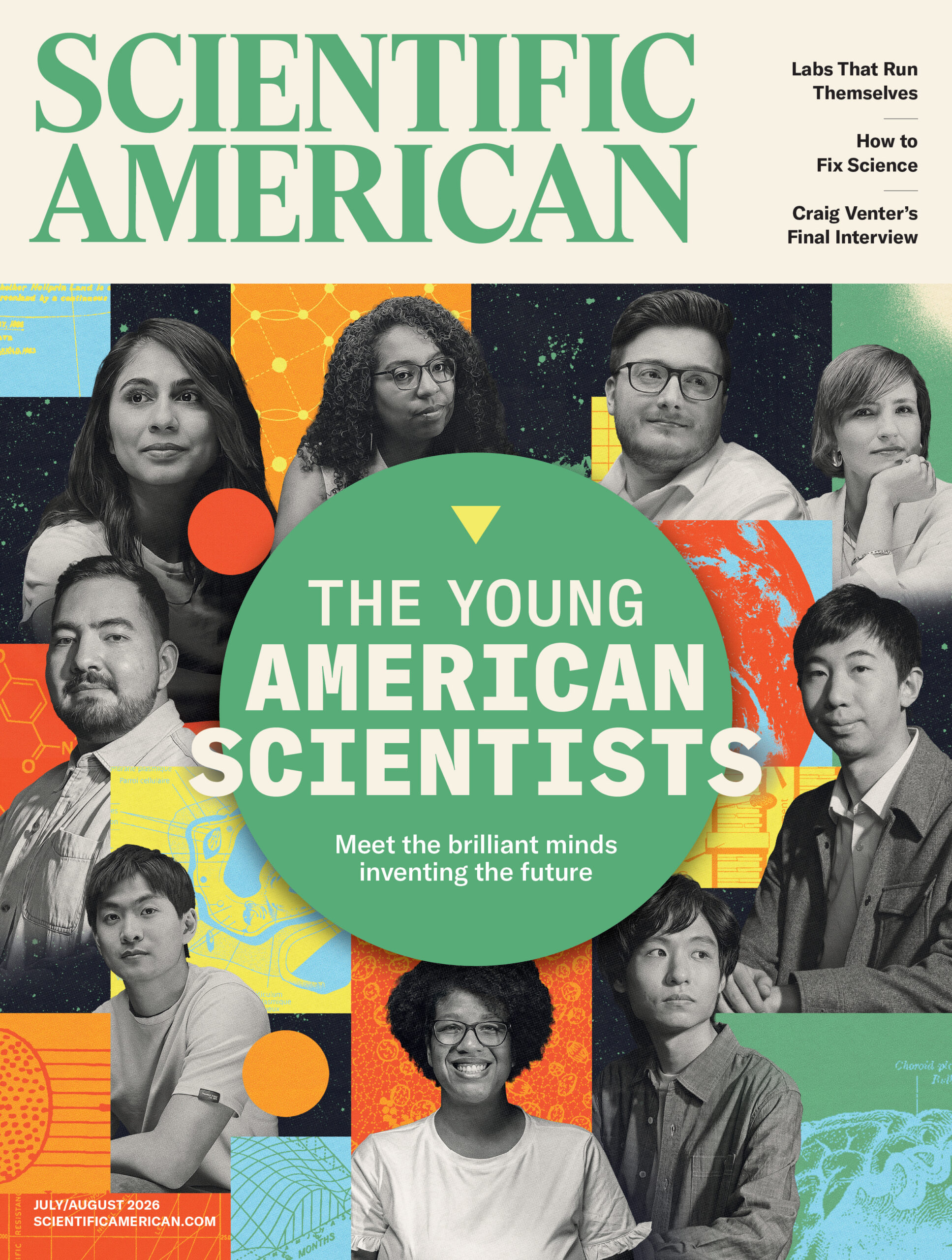
New York — Scientific American has announced its inaugural Young American Scientists list, recognizing 28 early-career researchers whose work is helping shape the future of science and society.
The Class of 2026 includes scientists working across fields such as healthcare, artificial intelligence, astronomy, botany, genomics, public health and space research. Scientific American said the list highlights the breadth and global reach of scientific innovation in the United States.
“Launched at a pivotal moment for the scientific community when ECRs face unique challenges, the initiative aims to spotlight burgeoning luminaries in American science,” the company said.
The selected researchers are working on advances with real-world impact, including disease treatment, emerging technologies and new areas of scientific discovery.
“The Class of 2026 is the result of months of global outreach and analysis,” said David Ewalt, Editor in Chief at Scientific American. “With this inaugural list, we wanted to highlight the extraordinary talent and promise across the U.S. and spotlight the researchers doing remarkable work today who are poised to make the world better tomorrow. Together, their work and achievements emphasize areas of scientific advancement and emerging opportunities.”
Scientific American said the list was developed through an extensive nomination and selection process. Researchers and experts from around the world nominated candidates across a range of disciplines. The publication’s editorial team then reviewed the nominees’ work using data-driven analysis and editorial judgment.
The list focuses on early-career researchers who have not yet reached full tenure. Honorees include graduate students, assistant professors and scientists working in industry and nonprofit settings. All honorees are under 40, with the youngest 24.
The Class of 2026 includes Tonima Annana of Wayne State University; Allie Balter-Kennedy of Tufts University; Samagya Banskota of Boston University; Jenny Bergner of the University of California, Berkeley; Adam Bowman of the Salk Institute for Biological Studies; Colin Carlson of Yale University School of Public Health; Steven Chavez of the University of California, Los Angeles; Jieneng Chen of Johns Hopkins University and Stanford University; Kauê Costa of the University of Alabama at Birmingham; Dane deQuilettes of Princeton University; Linus Chee-Huat Eng of Spatial Genomics, Inc.; Emily Finn of Dartmouth College; Jaye Gardiner of Tufts University; Trevor GrandPre of Washington University in St. Louis; Anna Ho of Cornell University; Kaiyi Jiang of Princeton University; JianJun Jin of New York Botanical Garden; Dmitrii Kochkov of Google Research; Mikhail Kolmogorov of the National Cancer Institute at the National Institutes of Health; Erini Lambrides of NASA Goddard Space Flight Center and the University of Maryland, College Park; Armita Manafzadeh of Yale University and Georgia Institute of Technology; Tixiao Shan of SRI International; Alice Stanton of Massachusetts General Hospital and Harvard Medical School; Christina Theodoris of Gladstone Institutes and the University of California, San Francisco; Xiao Yang of Johns Hopkins University; Amber Young of NASA; Alex Zhang of Massachusetts Institute of Technology; and Lvmin Zhang of Stanford University.
Scientific American said the Class of 2026 reflects the demographics and international nature of science in the United States, as well as the country’s continued role as a destination for scientific talent and innovation. The honorees work in settings ranging from large multinational companies to smaller startups and academic institutions.
The Young American Scientists list will anchor a print and digital package examining the state of science. Each honoree will be featured in a dedicated profile, with additional interviews and topical content available online.
The issue will also include a final interview with genomic scientist Dr. Craig Venter, features on the potential “brain drain” in American science, a look at artificial intelligence-driven laboratories, an analysis comparing today’s scientific landscape with the 1960s, and essays by Allan Lightman, Dava Sobel and other writers.
Scientific American said the list is expected to become an annual platform recognizing early-career scientific achievement and impact.
“This project is about recognizing not just individual achievement, but the collective momentum of a new generation,” said Jeanna Bryner, Executive Editor at Scientific American. “These scientists represent possibility and a powerful reminder of what science can achieve.”
The Young American Scientists Class of 2026 will appear in Scientific American’s upcoming issue and across its digital platforms.