

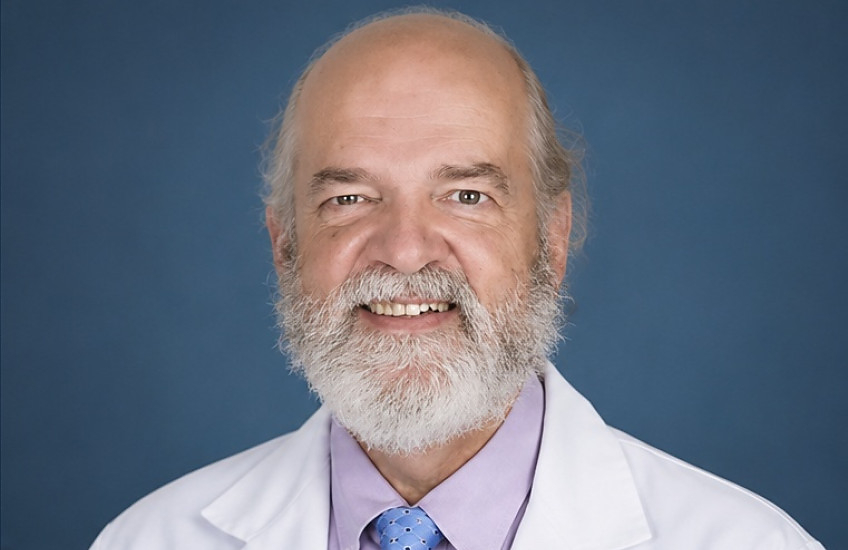
BOSTON–Lachlan Forrow, MD, a longtime Harvard Medical School Physician and Medical Ethicist who helped shape palliative care and clinical ethics at Beth Israel Deaconess Medical Center, has been selected to receive the inaugural Lifetime Achievement Award from the Albert Schweitzer Fellowship.
The award recognizes Forrow’s more than four decades of contributions to bioethics, compassionate patient care, medical education and community health leadership.
The honor was presented during the Albert Schweitzer Fellowship’s 2026 National Leadership Summit, held November 5-8 in Tulsa, Oklahoma, as the organization celebrated its 35th anniversary.
Forrow spent much of his medical career at Boston’s Beth Israel Deaconess Medical Center (BIDMC), where he founded and directed the hospital’s ethics and palliative care programs.
His work helped establish approaches to caring for patients facing serious illnesses, emphasizing the importance of patient dignity, ethical decision-making and compassionate communication between physicians, patients and families.
A longtime member of the Harvard Medical School faculty, Forrow also played an influential role in educating generations of physicians and medical professionals about the ethical responsibilities of clinical practice.
“There is no one more fitting to honor at our 35th anniversary,” said Rachel Gold, National Executive Director of the Albert Schweitzer Fellowship. “Under Lachlan’s leadership, ASF grew from a single Boston program into a national network by mentoring Fellows one at a time and working in tandem with colleagues across the country who shared his vision for service and leadership. Thirty-five years later, 5,000+ Fellows have been transforming healthcare principles into tangible, community-rooted health equity efforts across the nation.”
Forrow’s association with the fellowship began in 1982, when he was a senior medical student at Harvard Medical School.
That year, he spent three months working at the Albert Schweitzer Hospital in Lambaréné, Gabon, as a Schweitzer Fellow.
The experience influenced his subsequent career, reinforcing his commitment to medical service, humanitarian work and the belief that compassionate care should remain central to the practice of medicine.
After decades of clinical and academic service, Forrow retired from his faculty position at Beth Israel Deaconess Medical Center in 2020.
He subsequently continued his academic involvement through 2025 as a Senior Fellow at the Harvard Medical School Center for Bioethics, a part-time Lecturer in the Department of Global Health and Social Medicine, and a Faculty Associate at Harvard University’s Edmond & Lily Safra Center for Ethics.
His contributions to medical ethics have been particularly influential in helping physicians navigate difficult questions involving end-of-life care, treatment decisions and the responsibilities of healthcare professionals toward patients facing serious medical conditions.
“Lachlan Forrow’s commitment to advancing health and humanism in medicine makes him most deserving of this recognition,” said Rebecca Weintraub Brendel, MD, JD, Director of the Harvard Medical School Center for Bioethics and the Frances Glessner Lee Associate Professor of Global Health and Social Medicine in the Field of Legal Medicine.
“He has cultivated an environment of medical learning and care grounded in humility and compassion for his students, house staff, and colleagues in practice alike over more than 40 years. He has shaped the clinical and ethics communities at Harvard Medical School immeasurably by reliably asking the first question in nearly every setting — and providing the final reflection — on the most challenging clinical cases and ethical quandaries.”
Beyond his work in Boston’s medical community, Forrow has been involved in international humanitarian and peace initiatives.
He previously served as Board Chair and Chief Executive Officer of International Physicians for the Prevention of Nuclear War, an organization awarded the Nobel Peace Prize in 1985 for its efforts to raise awareness about the medical consequences of nuclear conflict.
He was also actively involved with the International Campaign to Abolish Nuclear Weapons, which received the Nobel Peace Prize in 2017.
Forrow’s leadership extended to the Albert Schweitzer Fellowship, where he served for many years as Chair of the Board.
During his tenure, the organization expanded from a Boston-based initiative into a national network supporting graduate and professional students pursuing community health projects.
Beth Israel Deaconess Medical Center served as the fellowship’s national office from 1992 through 2025, strengthening the organization’s longstanding connections to Boston’s healthcare and academic institutions.
“Whatever I’ve contributed to ASF is through the Fellows themselves,” said Dr. Lachlan Forrow, Board Chair Emeritus of ASF. “As a Lambaréné Schweitzer Fellow in 1982, working as a medical student at the Schweitzer Hospital in Africa, I learned that Schweitzer-spirited service is not episodic, it is a profoundly-rewarding lifelong pursuit. It is a great honor to be recognized by ASF, which today selects and supports over 200 new Schweitzer Fellows every year, and already over 5,000 Schweitzer Fellows for Life who continue to serve their communities, across the country and the world, long after their initial Schweitzer Fellowship year ends.”
The Albert Schweitzer Fellowship traces its origins to 1940, when supporters of humanitarian physician Albert Schweitzer established an American organization to provide financial and material assistance to his hospital in Gabon.
The organization’s modern U.S. fellowship program was established in Boston in 1991 and has since expanded nationwide.
The fellowship supports graduate and professional students in medicine, public health, law, social work and other disciplines who develop projects addressing unmet health needs in underserved communities.
Since its establishment, the program has supported more than 5,000 Fellows, whose community-based initiatives collectively serve approximately 23,000 people annually across the United States.
The current fellowship cohort includes nearly 250 participants working on projects addressing a range of healthcare challenges.
Among the initiatives are mobile wound-care clinics serving people experiencing homelessness in North Carolina, dental services for individuals recovering from substance use disorders in California, programs addressing social isolation among older adults in Vermont, and maternal mental health support services in Oklahoma.
The fellowship’s Lifetime Achievement Award recognizes Forrow’s contributions to both medical practice and the development of future healthcare leaders, particularly his efforts to integrate ethical decision-making, humanitarian service and patient-centered care into medical education and clinical practice.
His career reflects the longstanding role of Boston’s academic medical community in advancing medical ethics, palliative care and healthcare leadership beyond traditional clinical settings.
