

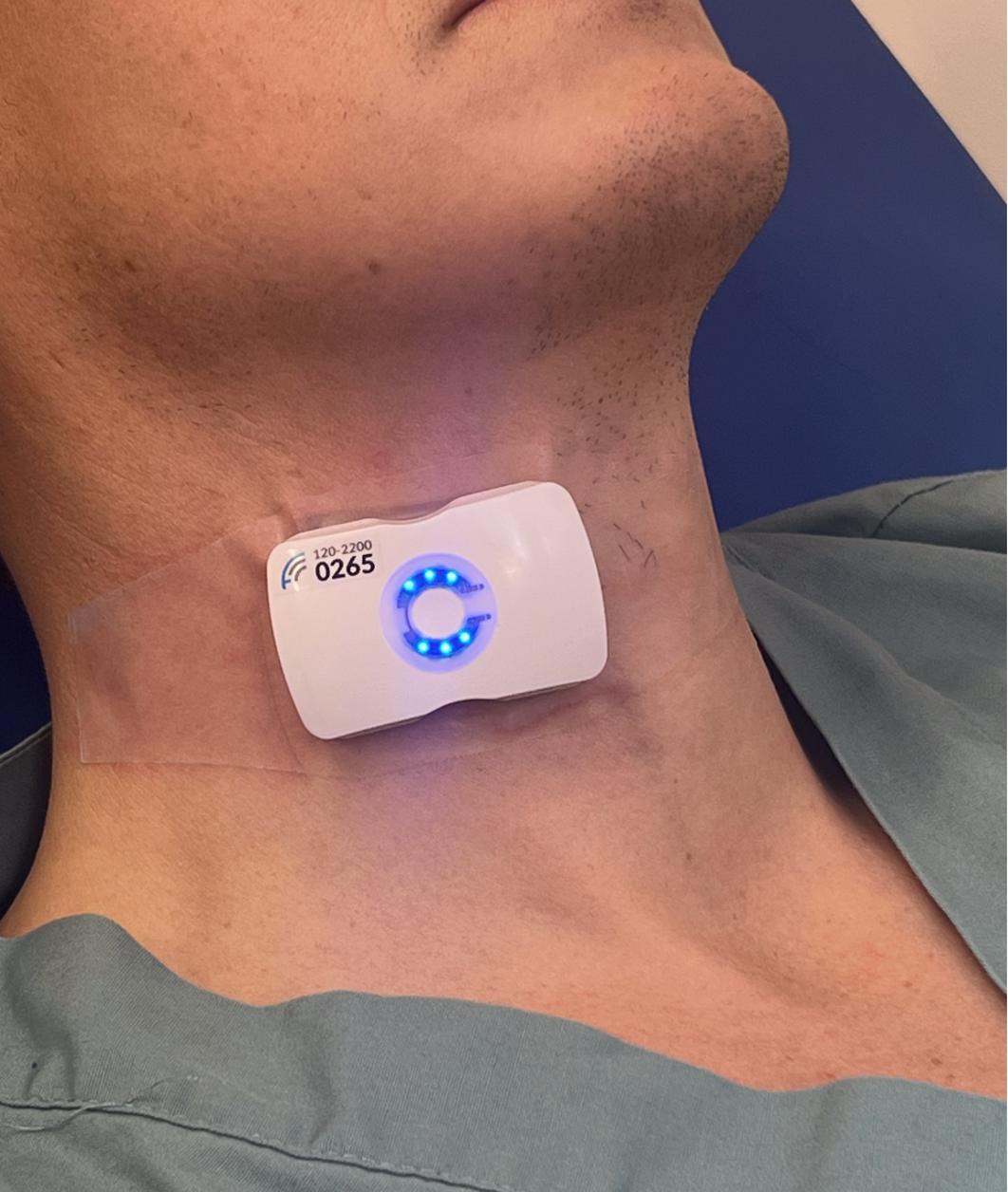
LOS ANGELES — Flosonics Medical said it has entered into a development contract with the Biomedical Advanced Research and Development Authority to develop an AI-enabled trauma capability for its FloPatch wearable ultrasound device.
The contract supports development of FloPredict, software designed to help clinicians identify patients at risk from internal bleeding following traumatic injury.
BARDA, part of the U.S. Department of Health and Human Services, is providing approximately $15 million in initial funding. The contract could be worth up to approximately $70 million if all options are exercised.
The project is being funded through BARDA’s Burn and Blast Medical Countermeasures program and is intended to strengthen trauma and mass casualty response capabilities, including situations such as a nuclear detonation.
FloPatch is an FDA-cleared wireless Doppler ultrasound device that provides real-time, non-invasive hemodynamic measurements to help clinicians make decisions about fluid resuscitation.
Flosonics said the device has been used on more than 13,000 patients at more than 30 U.S. hospitals, including in patients with sepsis, hypotension and other critical care conditions.
Under the BARDA collaboration, Flosonics will develop FloPredict, an AI algorithm that analyzes Doppler signals collected by FloPatch. The company said the software could help clinicians identify patients at risk of complications from internal hemorrhage who may require urgent treatment.
“Partnering with the U.S. government on a capability of this importance is a milestone for Flosonics,” said Joe Eibl, CEO and Co-Founder of Flosonics Medical.
“There is a real gap in how clinicians detect internal bleeding in the critical minutes after injury, and this award lets us build toward closing it. It also reflects the broader potential of FloPatch: the same real-time assessment clinicians rely on in critical care today can be extended to the settings where fast answers matter most,” Eibl added.
“We built FloPatch so that any clinician could see a patient’s physiology in real time at the bedside, without waiting for a specialist. FloPredict will apply that same principle in trauma care,” said Jon-Emile Kenny, CMO and Co-Founder of Flosonics Medical.
“The goal is software that recognizes hemodynamic patterns preceding deterioration from hemorrhage and surfaces them early enough to act on,” Kenny added.